
Hello world!
Welcome to WordPress. This is your first post. Edit or delete it, then start writing!
Read More →
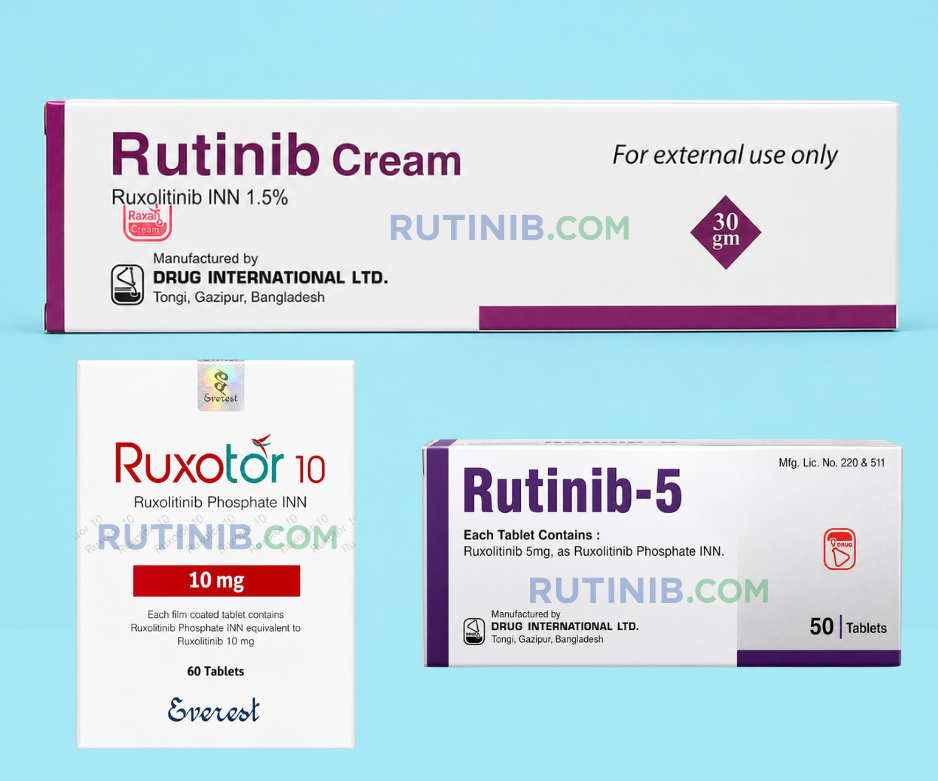
Rutinib.com provides educational information about three products identified on this website as containing ruxolitinib:
Rutinib Cream (Ruxolitinib) — topical formulation
Rutinib 5 mg (Ruxolitinib) — oral formulation
Ruxotor 10 mg (Ruxolitinib) — oral formulation
Although these products are associated with the same active ingredient, they should not be considered automatically interchangeable. The route of administration, formulation, strength, systemic exposure, approved uses, dosing, monitoring requirements and regulatory labeling can differ substantially.
Ruxolitinib is a Janus kinase (JAK) inhibitor that primarily inhibits JAK1 and JAK2. JAK signaling participates in pathways used by cytokines and growth factors involved in immune regulation, inflammation and hematopoiesis. Inhibiting these pathways can alter signaling associated with certain inflammatory, immune-mediated and hematologic diseases.
The information on this website is intended for general educational purposes. The specific identity, manufacturer, marketing authorization holder and regulatory status of each Rutinib-branded product should be confirmed against its actual packaging and applicable regulatory documentation before publication or use.
Drug International Limited is a pharmaceutical manufacturer based in Bangladesh. The company was established in 1974 as a private limited company and later began pharmaceutical formulation and production. Its official company profile describes it as one of Bangladesh’s established pharmaceutical manufacturers, with a focus on quality, innovation, and international manufacturing standards.
Drug International has developed a broad pharmaceutical portfolio covering multiple therapeutic areas. Its products include medicines in areas such as oncology, cardiovascular care, antibiotics, respiratory medicine, gastroenterology, neurology, and diabetes. The company also manufactures products in different dosage forms, including tablets, capsules, injections, syrups, suspensions, creams, ointments, and soft gelatin capsules.
One of the company’s notable areas of specialization is soft gelatin capsule manufacturing. Drug International states that it was the first company in Bangladesh to formulate medicines in soft capsule form and has maintained a strong position in this field.
Drug International reports that its manufacturing facilities are designed and operated according to WHO Good Manufacturing Practices (WHO-cGMP) concepts and applicable local pharmaceutical regulations. Its facilities include production areas, quality-control laboratories, product-development laboratories, engineering facilities, water-treatment systems, and an effluent-treatment plant.
Head Office: Khwaja Enayetpuri (R) Tower17, Bir Uttam K.m. Shafiullah Road (Green Road),dhaka-1205, Bangladesh.
Factory – 1: 252, Tongi Industrial Area, Tongi, Gazipur, Bangladesh.
Factory – 2: 13A & 14A, Tongi I/A, Squibb Road, Tongi, Gazipur, Bangladesh.
Factory – 3: 31/1, Satrong Road, Gopalpur, Tongi Industrial Area, Gazipur, Bangladesh.
Factory (HERBAL & UNANI): Plot #100, 103-106, Block – A, Kathaldia, Tongi I/A, Tongi, Gazipur.
Rutinib is the product name used on this website for products identified as containing ruxolitinib. Ruxolitinib is a prescription JAK1/JAK2 inhibitor that is available in both systemic oral formulations and topical formulations.
The three products covered on Rutinib.com represent different pharmaceutical presentations:
| Product | Active ingredient | Route | Stated strength/form |
|---|---|---|---|
| Rutinib Cream | Ruxolitinib | Topical | Cream |
| Rutinib 5 mg | Ruxolitinib | Oral | 5 mg |
| Ruxotor 10 mg | Ruxolitinib | Oral | 10 mg |
The presence of the same active ingredient does not mean that these products have the same approved indications, dosage instructions, exposure or safety profile.
Rutinib Cream is identified on this website as a topical product containing ruxolitinib.
The established U.S. reference product for topical ruxolitinib is OPZELURA (ruxolitinib) cream. OPZELURA is a topical JAK inhibitor developed by Incyte Corporation. The FDA approved OPZELURA in September 2021 for certain patients with mild-to-moderate atopic dermatitis, and subsequently approved it for nonsegmental vitiligo in adults and pediatric patients 12 years and older.
Current U.S. labeling identifies OPZELURA as a 1.5% ruxolitinib cream. Its topical regulatory history is separate from the oral JAKAFI product.
Rutinib Cream should therefore not be described as OPZELURA or as identical to OPZELURA unless product-specific regulatory documentation establishes that relationship.
| Attribute | Rutinib Cream | OPZELURA |
|---|---|---|
| Active ingredient | Ruxolitinib, as identified on this website | Ruxolitinib |
| Route | Topical | Topical |
| Dosage form | Cream | Cream |
| Reference status | – | Established U.S. reference product |
| Developer/originator history | – | Incyte |
| Specific manufacturer | – | Product labeling should be consulted |
| Regulatory status | – | FDA-approved |
The specific manufacturer, formulation strength, manufacturing site and authorization pathway for Rutinib Cream should be verified from the product packaging and official documentation before these details are presented as established facts.
Rutinib 5 mg is identified on this website as an oral ruxolitinib product containing a stated 5 mg strength.
Oral ruxolitinib has a different therapeutic role from topical ruxolitinib. In the United States, the established reference product is JAKAFI (ruxolitinib), which is marketed by Incyte. The FDA records the initial U.S. approval of JAKAFI in 2011.
Current U.S. JAKAFI labeling includes treatment of specified patients with:
Myelofibrosis
Polycythemia vera
Steroid-refractory acute graft-versus-host disease
Chronic graft-versus-host disease after failure of one or two lines of systemic therapy
The applicable age, disease characteristics, prior treatment requirements and dosing criteria differ according to the indication.
Rutinib 5 mg should therefore not be presented as having every indication of JAKAFI unless the Rutinib product has the corresponding authorization in the relevant jurisdiction.
Ruxotor 10 mg is identified on this website as an oral product containing ruxolitinib in a stated 10 mg strength.
A 10 mg tablet represents the amount of ruxolitinib in the dosage unit; it does not represent one universal treatment dose for every condition.
The appropriate oral ruxolitinib regimen depends on factors such as:
The disease being treated
Baseline blood counts
Platelet count
Treatment response
Adverse reactions
Liver function
Kidney function
Concomitant medicines
Applicable prescribing information
Current U.S. JAKAFI labeling, for example, uses different starting regimens according to the indication and clinical characteristics of the patient.
Therefore, Ruxotor 10 mg should not be described as a standard dose for all patients.
Ruxolitinib has more than one established reference-product history because it has been developed in different formulations.
The major U.S. reference product for oral ruxolitinib is JAKAFI (ruxolitinib).
The FDA records the initial U.S. approval of JAKAFI in 2011, with Incyte Corporation identified as the company associated with the product.
Incyte currently states that JAKAFI is marketed by Incyte in the United States. Outside the United States, ruxolitinib has been licensed to Novartis and marketed in many markets as JAKAVI.
For topical ruxolitinib, the established U.S. reference product is OPZELURA (ruxolitinib) cream.
The FDA records OPZELURA’s initial U.S. approval in 2021. Incyte is identified as the applicant/company associated with the product.
This distinction is important because JAKAFI and OPZELURA are not simply different strengths of the same dosage form. One is an oral systemic product and the other is a topical cream.
Ruxolitinib is an Incyte-discovered medicine. Incyte identifies ruxolitinib as a JAK1/JAK2 inhibitor within its hematology and dermatology portfolio and describes JAKAFI and OPZELURA as its marketed ruxolitinib products in the United States.
The company’s current portfolio identifies:
JAKAFI (ruxolitinib) — JAK1/JAK2 inhibitor
OPZELURA (ruxolitinib) cream — JAK1/JAK2 inhibitor
Incyte’s corporate information also states that JAKAFI is marketed by Incyte in the U.S., while ruxolitinib is licensed to Novartis outside the U.S. for specified hematology and oncology uses.
These terms should not be treated as interchangeable.
The originator or developer is the company responsible for discovering and developing the medicine or reference product.
For ruxolitinib, Incyte is the documented developer associated with the medicine’s originator history.
For the United States, the principal reference products discussed on this website are:
JAKAFI — oral ruxolitinib
OPZELURA — topical ruxolitinib cream
The manufacturer of the specific products identified as:
Rutinib Cream
Rutinib 5 mg
Ruxotor 10 mg
is not established by the supplied product information.
Accordingly, the website should not state that Incyte manufactures Rutinib or Ruxotor unless official product-specific documentation proves that relationship.
This distinction is especially important for pharmaceutical websites because the developer of an active ingredient, reference-product company, manufacturer of a particular generic or branded-generic product, marketing authorization holder, distributor and supplier can be different entities.
Public regulatory sources reviewed for the reference products establish Incyte’s role as developer/applicant and marketer, but they do not provide sufficient evidence here to make a definitive statement about a separate “first manufacturing company” for every Rutinib-branded product.
Therefore, the safest publication wording is:
Ruxolitinib was discovered and developed by Incyte, while the manufacturer of the specific Rutinib-branded product should be verified from its official product documentation.
This avoids incorrectly attributing a generic or branded-generic product to the originator company.
Ruxolitinib is a Janus kinase inhibitor that primarily inhibits JAK1 and JAK2.
JAK proteins participate in intracellular signaling pathways activated by various cytokines and growth factors. These signaling pathways influence immune activity, inflammatory responses and blood-cell production.
By inhibiting JAK1 and JAK2 signaling, ruxolitinib can modify signaling pathways involved in certain hematologic and inflammatory disorders.
The pharmacologic mechanism does not mean that all ruxolitinib products have the same clinical applications. The therapeutic use depends on the formulation, route of administration and regulatory labeling.
| Feature | Rutinib Cream | Rutinib 5 mg | Ruxotor 10 mg |
|---|---|---|---|
| Active ingredient | Ruxolitinib | Ruxolitinib | Ruxolitinib |
| Route | Topical | Oral | Oral |
| Dosage form | Cream | Oral dosage form | Oral dosage form |
| Stated strength | Product-specific | 5 mg | 10 mg |
| Main therapeutic context | Dermatologic | Systemic | Systemic |
| Systemic exposure | Different from oral treatment | Systemic | Systemic |
| Reference-product context | OPZELURA | JAKAFI | JAKAFI |
| Product manufacturer | – | – | – |
| Automatic interchangeability | No | No | No |
The products should therefore be evaluated individually rather than treating them as interchangeable versions of the same medicine.
In the United States, OPZELURA is approved for specified patients with mild-to-moderate atopic dermatitis and for nonsegmental vitiligo in adults and pediatric patients 12 years and older.
These indications belong to the approved labeling of OPZELURA and should not automatically be attributed to Rutinib Cream unless the specific Rutinib product carries the corresponding authorization.
Current U.S. JAKAFI labeling includes:
Myelofibrosis in specified patients
Polycythemia vera in adults with inadequate response or intolerance to hydroxyurea
Steroid-refractory acute graft-versus-host disease in adults and pediatric patients 12 years and older
Chronic graft-versus-host disease after failure of one or two lines of systemic therapy in adults and pediatric patients 12 years and older
Approved indications can differ between countries.
There is no single universal ruxolitinib dose that applies to Rutinib Cream, Rutinib 5 mg and Ruxotor 10 mg.
Oral dosing is indication-specific and may be adjusted according to blood counts, treatment response, organ function and adverse reactions.
For example, current U.S. JAKAFI labeling specifies different starting doses for myelofibrosis according to platelet count.
Therefore:
Rutinib 5 mg should not automatically be considered the standard dose.
Ruxotor 10 mg should not automatically be considered the standard dose.
Patients should not combine tablets to create a dose unless specifically instructed by their healthcare professional.
Dose changes should follow the applicable prescribing information.
The topical regimen is different from oral ruxolitinib. Current OPZELURA labeling contains formulation-specific administration instructions.
The dosing instructions for Rutinib Cream should be taken from the specific product’s approved labeling rather than assumed from OPZELURA.
Ruxolitinib safety depends significantly on the route of administration.
Because oral ruxolitinib produces systemic exposure, important safety considerations can include:
Thrombocytopenia
Anemia
Neutropenia
Infections
Bruising or bleeding
Dizziness
Headache
Weight gain
Elevated cholesterol
Other laboratory abnormalities
JAKAFI labeling includes important warnings and precautions concerning infections, malignancies, major cardiovascular events and thrombosis associated with JAK-inhibitor therapy.
Topical ruxolitinib also carries important warnings. Current OPZELURA labeling includes warnings concerning serious infections, mortality, malignancy, major adverse cardiovascular events and thrombosis associated with JAK inhibition, as well as cytopenias and other potential risks.
Topical administration does not mean that a medicine has zero systemic exposure or zero systemic safety considerations.
Monitoring requirements depend on the formulation and clinical indication.
For oral ruxolitinib, healthcare professionals may monitor:
Complete blood counts
Platelet counts
Hemoglobin
Neutrophil counts
Liver function
Kidney function
Signs of infection
Treatment response
Symptoms suggesting thrombosis or cardiovascular events
For topical ruxolitinib, monitoring may be based on the patient’s clinical circumstances and the applicable product labeling. Current OPZELURA labeling specifically notes CBC monitoring when clinically indicated in the context of cytopenias.
Scan the QR code printed on the product box. The QR code will take you to the official drug product verification page, where you can complete the verification process.
The QR code will direct you to the Drug International Ltd. e-verification page, where you can complete the product verification process.
After completing the verification, check the result carefully to confirm whether the product is genuine.
If the verification indicates that the product is fake or unauthorized, do not use it. Report the suspected counterfeit product and take appropriate legal action against the supplier through the Directorate General of Drug Administration (DGDA), World.
Always purchase medicines from licensed pharmacies or authorized suppliers and verify the product before use.
Rutinib products should not automatically be described as identical to JAKAFI or OPZELURA simply because they contain ruxolitinib.
A product may have the same active pharmaceutical ingredient while differing in:
Manufacturer
Excipients
Manufacturing site
Packaging
Regulatory authorization
Dosage form
Strength
Indication
Labeling
Distribution pathway
Therefore, the preferred wording is:
Rutinib is identified on this website as a product containing ruxolitinib. JAKAFI and OPZELURA are established reference products for oral and topical ruxolitinib, respectively. Product-specific equivalence, authorization and manufacturing information should be verified from official documentation.
Rutinib.com provides general educational information about ruxolitinib and products identified on the website as containing ruxolitinib.
This information does not replace:
A physician’s assessment
A pharmacist’s advice
Official prescribing information
Product-specific regulatory documentation
Individualized medical advice
Ruxolitinib is a prescription medicine. Patients should use it only under appropriate professional supervision and according to the prescribing information applicable to their country.
Do not start, stop, increase or decrease a prescribed ruxolitinib product solely because of information found on this website.
Rutinib is the product name used on this website for products identified as containing ruxolitinib. The website covers Rutinib Cream, Rutinib 5 mg and Ruxotor 10 mg.
The active ingredient identified for the Rutinib products on this website is ruxolitinib.
Rutinib Cream is identified as a topical ruxolitinib product. The established U.S. reference product for topical ruxolitinib is OPZELURA.
Rutinib 5 mg is identified as an oral ruxolitinib product containing a stated 5 mg strength.
Ruxotor 10 mg is identified as an oral ruxolitinib product containing a stated 10 mg strength.
Not necessarily. Rutinib and JAKAFI may contain the same active ingredient, but product-specific formulation, manufacturer, authorization and labeling must be verified.
Not automatically. OPZELURA is the established U.S. reference product for topical ruxolitinib. Rutinib Cream requires separate product-specific verification.
Ruxolitinib was discovered and developed by Incyte. Incyte currently markets JAKAFI and OPZELURA in the United States.
JAKAFI received its initial U.S. approval in 2011.
OPZELURA received its initial U.S. approval in 2021 for certain patients with atopic dermatitis.
Ruxolitinib primarily inhibits JAK1 and JAK2, enzymes involved in cytokine and growth-factor signaling.
No. A topical cream and an oral systemic product have different routes of administration and exposure and should not be substituted without appropriate professional and regulatory guidance.
Both are identified as containing ruxolitinib, but they have different stated strengths and product identities. They should not be treated as automatically interchangeable.
Do not make this substitution unless it is specifically authorized or instructed by the treating healthcare professional and is consistent with the applicable product labeling.
Current U.S. JAKAFI labeling includes specified uses in myelofibrosis, polycythemia vera and certain acute and chronic graft-versus-host disease settings.
Current U.S. OPZELURA labeling includes specified uses in mild-to-moderate atopic dermatitis and nonsegmental vitiligo.
Yes. Monitoring depends on the formulation and indication. Oral treatment commonly involves laboratory and clinical monitoring, while topical treatment also has formulation-specific safety considerations.
The specific manufacturer of Rutinib Cream, Rutinib 5 mg and Ruxotor 10 mg is not established by the supplied product information and should be verified from official product documentation.
This should not be stated unless product-specific documentation establishes that relationship. Incyte is the documented developer associated with ruxolitinib and the U.S. marketer of JAKAFI and OPZELURA.
JAKAFI (ruxolitinib) is the established U.S. reference product for oral ruxolitinib.
OPZELURA (ruxolitinib) cream is the established U.S. reference product for topical ruxolitinib.
Ruxolitinib is associated with Incyte Corporation, which discovered and developed the medicine. Incyte currently lists JAKAFI and OPZELURA within its marketed portfolio.
The FDA identifies Incyte as the company associated with both JAKAFI and OPZELURA in U.S. regulatory records. JAKAFI’s initial U.S. approval dates to 2011, while OPZELURA’s initial U.S. approval dates to 2021.
However, this originator history should not be confused with the manufacturer of a particular later branded or generic product.
For Rutinib and Ruxotor, manufacturer identity should be confirmed using:
Product packaging
Manufacturer documentation
Marketing authorization records
Regulatory databases
Official product information
Until such documentation is available, the manufacturer should be listed as: Drug International Ltd.
U.S. Food and Drug Administration — JAKAFI (ruxolitinib). FDA records identify the initial U.S. approval of JAKAFI as November 16, 2011 and identify Incyte Corporation as the sponsor.
DailyMed — JAKAFI/JAKAFI XR (ruxolitinib). Current U.S. labeling provides information on indications, dosing, warnings and administration.
U.S. Food and Drug Administration — OPZELURA (ruxolitinib) cream. FDA documentation records the initial approval of OPZELURA in 2021 and subsequent approval for nonsegmental vitiligo.
DailyMed — OPZELURA (ruxolitinib) cream. Current U.S. labeling provides information regarding indications, administration and JAK-inhibitor safety warnings.
Incyte — Pharmaceutical Portfolio. Incyte identifies JAKAFI and OPZELURA as ruxolitinib products and states that JAKAFI is marketed by Incyte in the United States.
Rutinib.com identifies Rutinib Cream, Rutinib 5 mg and Ruxotor 10 mg as products containing ruxolitinib. Ruxolitinib was discovered and developed by Incyte. JAKAFI is the established U.S. reference product for oral ruxolitinib, while OPZELURA is the established U.S. reference product for topical ruxolitinib. The specific manufacturer, marketing authorization holder and regulatory status of the Rutinib-branded products should be verified against official product documentation before publication.
This wording gives the website the originator/reference-product information you requested without incorrectly claiming that Incyte manufactures the Rutinib-branded products.
No. Rutinib Cream is a topical formulation, while Rutinib 5 mg and Ruxotor 10 mg are oral formulations. Their administration instructions, treatment contexts, dosing and safety considerations are different.
Both products are presented on Rutinib.com as oral products containing ruxolitinib, but they have different stated strengths. They should only be used according to the specific prescription and applicable product information.
No. A 10 mg tablet is a stated strength and does not represent one universal dosing schedule. The appropriate oral ruxolitinib regimen depends on the condition being treated, patient factors and the applicable prescribing information.
No. Rutinib 5 mg is an oral strength of ruxolitinib, but the appropriate dose and treatment schedule depend on the indication, patient characteristics, treatment response and other clinical factors.
Topical ruxolitinib can produce systemic exposure, so it should not automatically be considered completely limited to the skin. The extent of exposure can depend on factors such as the formulation, amount applied and treated body area.
Monitoring may be required during oral ruxolitinib treatment. Blood counts and other laboratory assessments may be used to evaluate treatment safety and determine whether dose adjustments or treatment changes are necessary.
No. Approved uses depend on the formulation, route of administration, dose, patient population and regulatory authorization. Indications for topical ruxolitinib should not automatically be applied to oral ruxolitinib.
No. Rutinib Cream and oral ruxolitinib products have different routes and treatment contexts. An indication established for oral ruxolitinib does not automatically establish the same use for topical ruxolitinib.
Confirm the exact product name, active ingredient, formulation, strength, directions for use, manufacturer, packaging, batch or lot number and expiry date. The product should also be obtained through a legitimate pharmaceutical supply channel.
No. The appropriate ruxolitinib formulation and dose depend on the condition being treated and individual clinical circumstances. A qualified healthcare professional should determine which product and regimen are appropriate.